
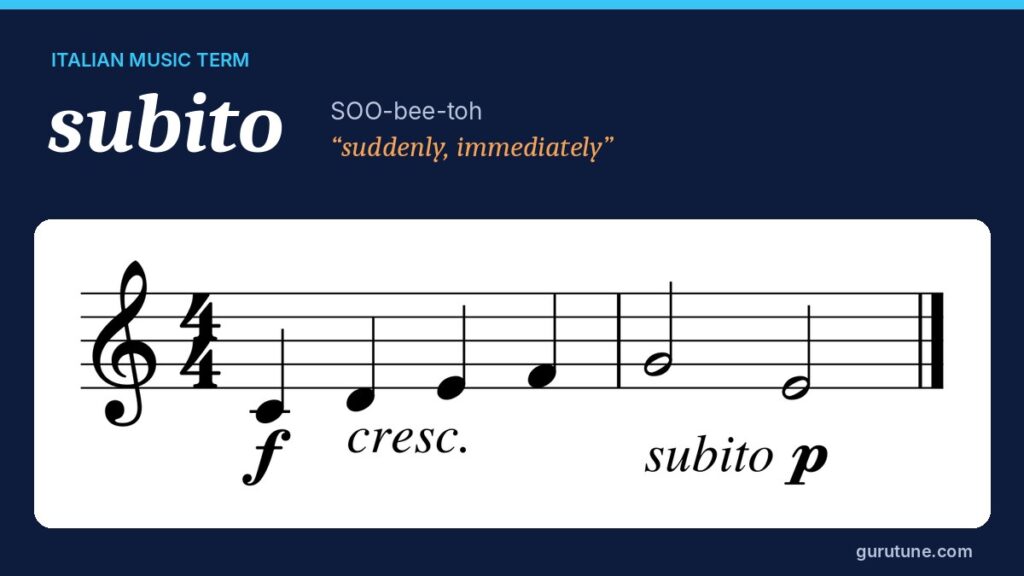
Subito is Italian for “suddenly” or “immediately”. It is placed before another instruction to show that the change must happen at once, with no gradual transition. The most common use is subito piano, a sudden drop to soft playing.
How to pronounce subito
Say it as SOO-bee-toh. The stress falls on the first syllable, not the second, which surprises many English speakers.
Common combinations
Subito rarely stands alone. It usually sharpens another marking:
- Subito piano, often written sub. p, means suddenly soft
- Subito forte, written sub. f, means suddenly loud
- Subito pianissimo means suddenly very soft
- Subito meno mosso means suddenly slower
- Subito più mosso means suddenly faster
- Volti subito, written V.S., means turn the page quickly
The last one is a practical instruction rather than a musical one. It appears at the bottom of a page when the music continues without a pause on the next page.
Why subito piano is so hard
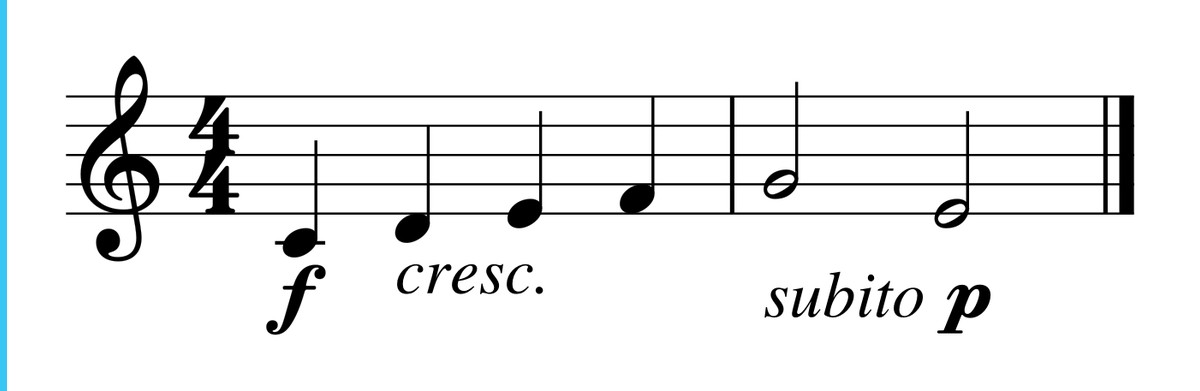
The classic subito moment comes right after a crescendo. The music grows louder and louder, and then, instead of reaching a climax, it drops to piano. The surprise is the whole point.
The difficulty is that musicians instinctively prepare changes. Before a soft passage, they start to back off a little, almost without noticing. That small preparation warns the audience, and the surprise is lost.
Beethoven was particularly fond of this effect. His music often builds up energy and then pulls the floor away at the last moment, so players who perform his works learn to handle subito early.
The trick that makes it work
The secret is to keep the old dynamic until the very last moment. Play the crescendo fully, all the way up to the note before the change. Then make the new level clear from the first note of the soft passage.
A tiny separation can help. Many players lift the sound for a fraction of a second before the subito note, a breath for singers and wind players, a fresh bow for string players. The silence is so short that listeners do not hear it as a pause, but it resets the sound.
Practising subito changes
Choose a simple scale. Play four notes with a crescendo, then make the fifth note suddenly soft. Record yourself and listen back. If you hear the volume starting to fall on note four, you prepared the change too early. Repeat until the drop happens exactly on note five.
Then practise the opposite: soft notes followed by a sudden forte. This direction is easier to hear but harder to control, because the loud note must be strong without being harsh.
Free printable card
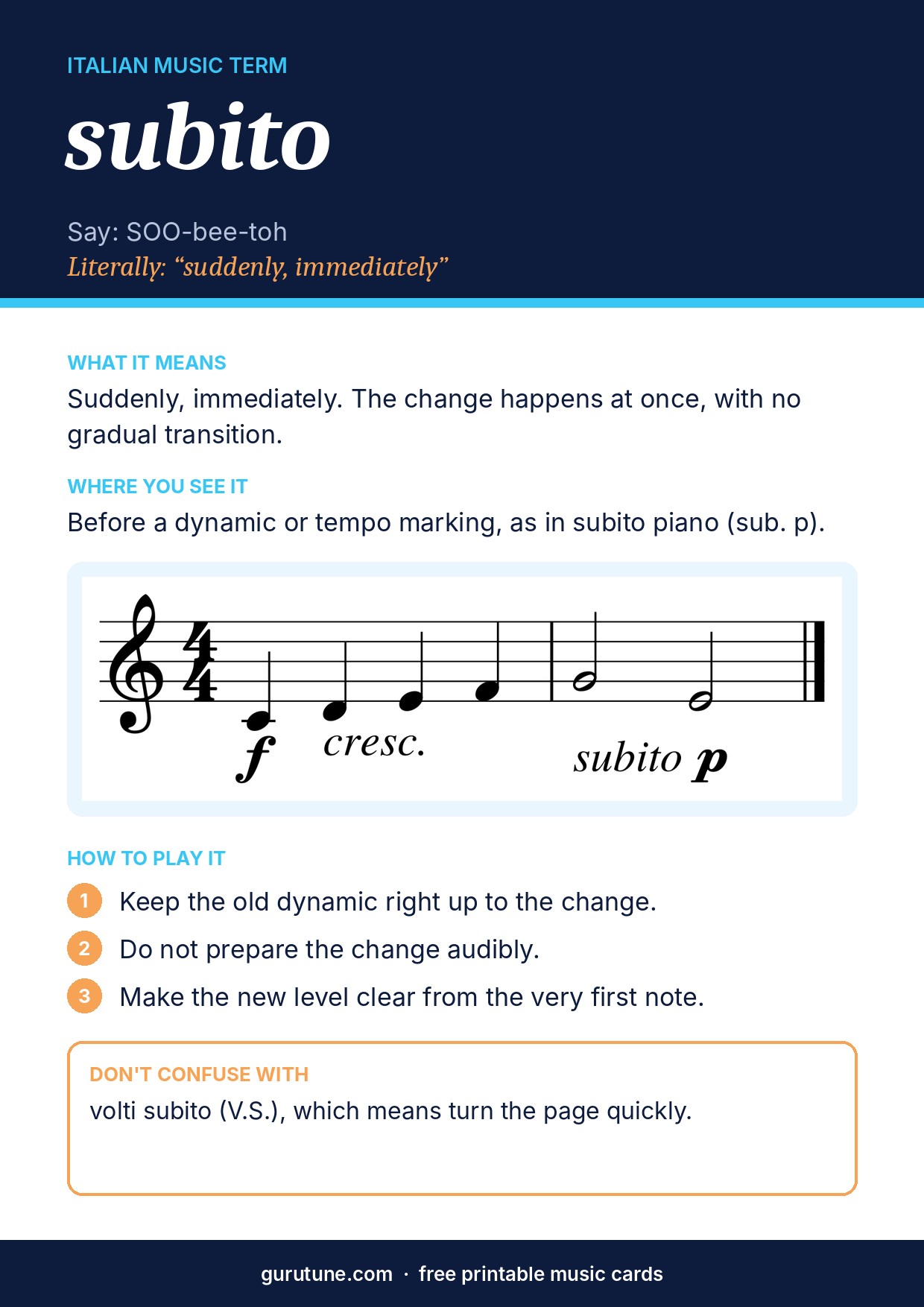
Print this card on A4 and keep it in your music folder or on the stand. Click the image to open it in full size.
For the short definition, see subito in our music dictionary.
Frequently asked questions
What does subito mean in music?
Subito is Italian for “suddenly” or “immediately”. It shows that a change must happen at once, without a gradual transition.
What does subito piano mean?
Subito piano, often written sub. p, means suddenly soft. It usually comes right after a loud passage or a crescendo.
How do you pronounce subito?
Subito is pronounced SOO-bee-toh, with the stress on the first syllable.
What does V.S. mean in sheet music?
V.S. stands for volti subito, meaning turn the page quickly, because the music continues straight away.
Why is subito piano difficult?
Musicians tend to prepare changes, so they start getting softer too early and give the surprise away.
How do you play a good subito piano?
Keep the loud dynamic right up to the change, then make the soft level clear from the very first note.