
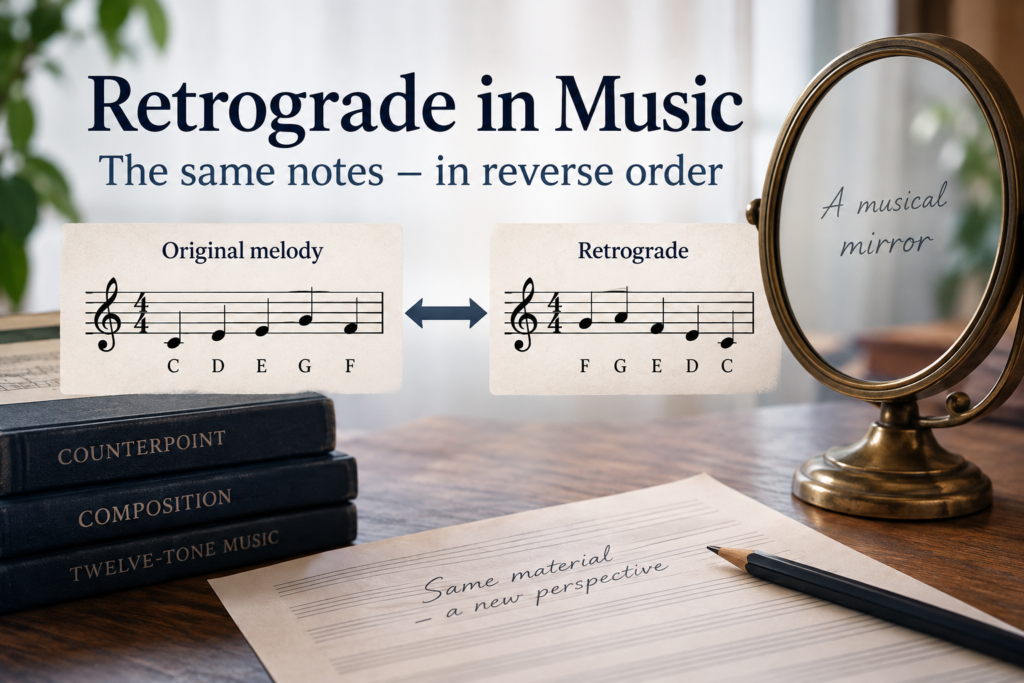
Retrograde in music is a compositional technique in which a melody, musical phrase, or series of notes is presented backwards. In other words, the final note of the original passage becomes the first note of the retrograde, the second-to-last note becomes the second note, and so on.
The technique is particularly associated with counterpoint, 20th-century composition, and twelve-tone music, but the idea of reversing musical material is much older. Retrograde can be used to create symmetry, develop an existing musical idea, or give a composition a strong sense of structural unity.
What does retrograde mean in music?
In music, retrograde means playing a sequence of notes in reverse order.
Imagine a melody consisting of these five notes:
C – D – E – G – F
Its retrograde would be:
F – G – E – D – C
The individual notes remain the same, but their order is reversed.
Retrograde is therefore different from simply transposing a melody. In transposition, the intervals and order remain the same while the entire passage is moved to another pitch level. In retrograde, the order of the notes changes.
How does retrograde work?
Learn retrograde music theory
To create a retrograde, the composer takes an existing musical passage and reverses its sequence.
For example:
Original:
C – E – G – A – F
Retrograde:
F – A – G – E – C
This can be applied to a melody, a melodic fragment, a rhythm, or a larger musical structure.
Retrograde does not necessarily mean that the reversed passage will sound like an obvious mirror image. When listeners hear the retrograde separately from the original, it may simply sound like a new melody.
The connection becomes more apparent when the original and retrograde are used together.
Retrograde and counterpoint
Retrograde has an important place in the history of counterpoint.
In contrapuntal writing, composers can manipulate a subject or theme in several ways. A theme may be inverted, transposed, augmented, diminished, or presented in retrograde.
A melody in retrograde can be combined with the original form, creating a relationship between two musical lines that is based on reversal.
These techniques are especially useful when a composer wants musical material to remain recognisably connected while appearing in different forms.
Retrograde inversion
One of the most important related techniques is retrograde inversion.
Retrograde inversion combines two operations:
- The melody is inverted, changing the direction of its intervals.
- The resulting sequence is reversed.
For example, if a musical idea is represented by a sequence of intervals, inversion changes ascending intervals into descending intervals and vice versa. Retrograde then reverses the order.
Retrograde inversion therefore produces a transformation that is related to the original material but considerably more complex than simple reversal.
Retrograde in twelve-tone music
Retrograde became particularly prominent in twelve-tone composition.
In twelve-tone music, a composer works with a specific ordering of all twelve notes of the chromatic scale, known as a tone row or twelve-tone row. The row can then be transformed in several standard ways.
The four basic forms are:
- Prime (P): the original row
- Inversion (I): the intervals are inverted
- Retrograde (R): the row is played backwards
- Retrograde inversion (RI): the inverted row is played backwards
These transformations allow a composer to generate a large amount of musical material from a single underlying row.
The technique is strongly associated with composers such as Arnold Schoenberg, Anton Webern, and Alban Berg, who developed and explored twelve-tone composition in the early 20th century.
Schoenberg’s Suite for Piano, Op. 25, written between 1921 and 1923, was the first work he built entirely from one twelve-tone row. Every melody and chord in it comes from those 12 notes, heard in their original order, upside down, backwards, or both at once. Retrograde was among the four tools that let such a small starting point fill a whole composition without sounding repetitive.
Retrograde does not have to be exact
A composer does not always need to reverse every detail of a passage literally.
Retrograde can be applied selectively. A composer might reverse:
- the pitches of a melody
- the rhythm
- the order of motifs
- a short phrase
- an entire section
- a twelve-tone row
The result depends on which musical elements are being reversed.
For example, reversing the pitches while retaining the original rhythm produces something different from reversing both pitch and rhythm.
Why do composers use retrograde?
Retrograde is primarily a compositional technique, rather than a musical effect that listeners are expected to identify immediately.
It can be used to:
- develop existing musical material
- create structural symmetry
- establish relationships between sections
- generate new melodies from existing ones
- create unity within a composition
- explore musical transformation
- organise atonal or serial music
The technique can also produce a sense of balance between different parts of a composition.
Retrograde and musical symmetry
One reason retrograde is interesting is its relationship with symmetry.
If a musical passage appears in its original form and later returns in retrograde, the two passages are related like two sides of a musical mirror.
This kind of symmetry can occur over a short phrase or across an entire composition. It can be obvious to the listener, but it can also operate at a structural level without being consciously recognised.
Is retrograde the same as playing music backwards?
Not necessarily.
In everyday language, playing a recording backwards means reversing the entire recording. Every sound, attack, decay, and rhythmic event is reversed.
Retrograde in music usually refers to reversing the order of musical events, particularly pitches or notes, rather than literally turning an audio recording backwards.
This distinction is important. A melody played in retrograde is not the same thing as a recording played backwards.
Famous uses of retrograde
Retrograde has been explored by many composers, particularly those interested in counterpoint, symmetry, serialism, and systematic musical structures.
It became especially significant in the works of the Second Viennese School and later composers influenced by serial techniques.
However, the broader concept of reversing musical material is not limited to twelve-tone music. It can be found in many forms of compositional practice where a composer transforms an existing musical idea.
How to identify retrograde
When analysing a piece of music, look for a passage that appears to contain the same sequence of pitches as an earlier passage but in reverse order.
For example:
First occurrence:
A – C – D – F – E
Later occurrence:
E – F – D – C – A
The second passage is the retrograde of the first.
The rhythm, register, harmony, and instrumentation may be different, so the relationship may not be immediately obvious.
Retrograde vs. inversion
Retrograde and inversion are sometimes confused, but they are different transformations.
Retrograde: reverses the order of the notes.
Inversion: changes the direction of the intervals.
If a melody moves upward by a certain interval, its inversion moves downward by the corresponding interval. The order of the notes itself is not reversed.
Retrograde inversion combines both operations.
Understanding these three transformations is particularly important when studying twelve-tone and serial music.
Conclusion
Retrograde in music is the technique of presenting musical material in reverse order. A melody, motif, rhythm, or tone row can be transformed into its retrograde form by reversing the sequence of its elements.
The technique provides composers with a way to transform existing material while preserving a clear structural relationship to the original. It is particularly important in counterpoint and twelve-tone composition, where retrograde, inversion, and retrograde inversion form part of a systematic approach to musical transformation.
Retrograde is therefore more than simply “playing a melody backwards”. It is a compositional device that allows the same musical idea to appear from a different direction.
Frequently Asked Questions
Retrograde is a compositional technique in which the notes of a melody, motif, or tone row are presented in reverse order.
If a melody is C–D–E–G–F, its retrograde is F–G–E–D–C.
Retrograde reverses the order of the notes, while inversion reverses the direction of the intervals.
Retrograde inversion combines inversion and retrograde: the intervals are inverted and the resulting sequence is reversed.
Retrograde has been used in various forms of composition, but it became particularly important in the twelve-tone music of composers such as Arnold Schoenberg, Anton Webern, and Alban Berg.
No. Retrograde normally refers to reversing the order of musical events, rather than literally reversing an audio recording.