
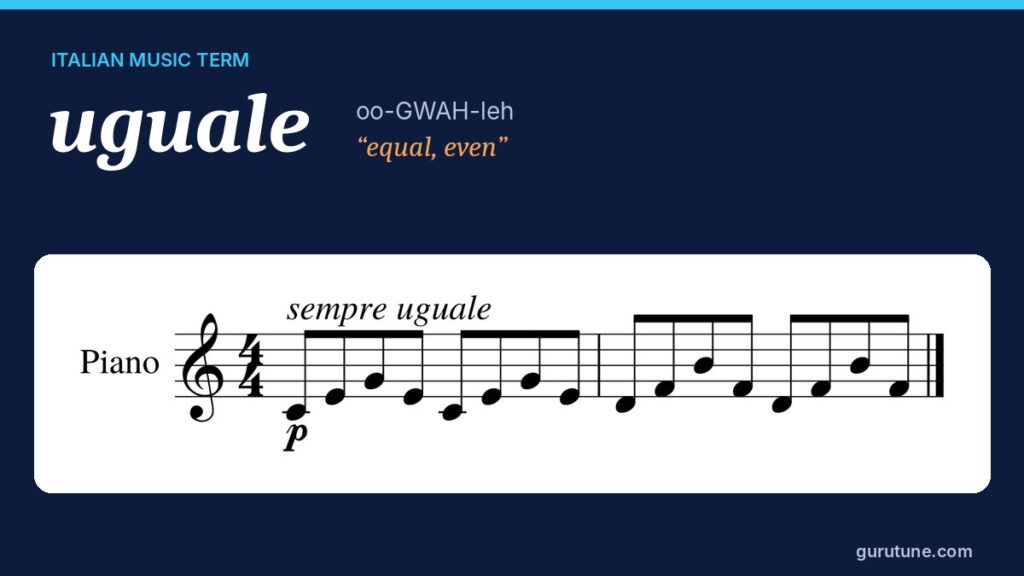
Uguale is Italian for “equal” or “even”. In a score it asks the performer to keep something exactly the same: the length of the notes, the volume, the tempo or the weight of each beat. It sounds like a simple request, but it is one of the hardest things to do well.
How to pronounce uguale
Say it as oo-GWAH-leh, with the stress on the middle syllable. The older spelling eguale is pronounced eh-GWAH-leh and means the same thing.
Where uguale appears
The word often stands alone, but it is just as common in combinations:
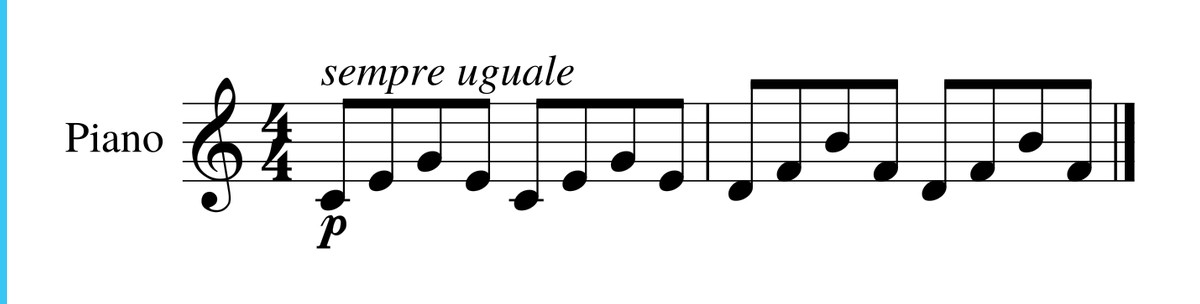
- Sempre uguale means “always even” and appears over long repeated patterns
- Parti uguali means “equal parts” and describes parts of the same weight or kind
- Uguale is sometimes placed over accompaniment figures that must not compete with the melody
- Voci uguali means “equal voices” and describes music for voices of the same kind, for example only female or only male singers
Why composers write it
Players naturally make music uneven. They lean on the first note of a group, rush through easy passages and slow down in difficult ones. Most of the time this is part of expressive playing. Uguale is the composer’s way of saying that, here, the effect depends on perfect evenness.
Repeated patterns are the typical case. A rippling accompaniment, a soft tremolo or a running bass line can create a calm, hypnotic background, but only if no single note sticks out. One accented note breaks the spell.
Equal and equale in music history
The same Latin root gives us the word equale, used for pieces written for a group of equal instruments. Beethoven’s Drei Equale, WoO 30, written in 1812 for four trombones, is a famous example. The title tells you that the four players are equal partners of the same kind. Two of the pieces, arranged for trombones and male voices, were later performed in Beethoven’s own funeral procession in 1827.
How to practise playing uguale
Evenness is trained slowly and with attention.
- Start with a metronome at a tempo where every note feels easy
- Record yourself and listen for notes that are louder or longer than their neighbours
- Practise with different rhythms, such as long and short, then return to even notes
- Increase the tempo only when the slow version is completely even
- Pay special attention to the thumb on keyboard instruments and to string crossings on bowed instruments, as these often cause bumps
The final test is to keep the evenness when the passage becomes hard. Uguale is easy on a simple scale and much harder in a tricky figure. That is exactly where composers tend to write it.
Free printable card
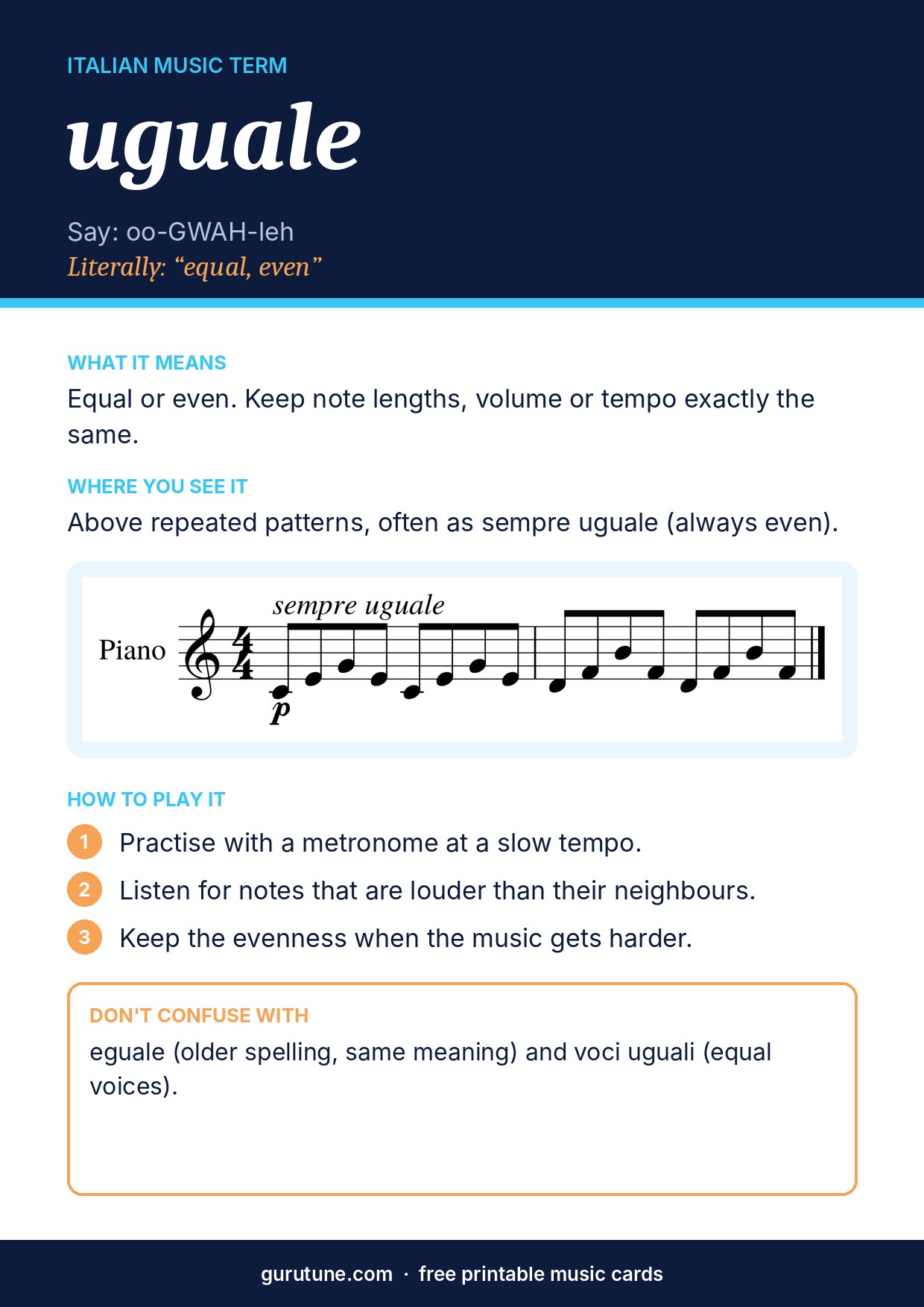
Print this card on A4 and keep it in your music folder or on the stand. Click the image to open it in full size.
For the short definition, see uguale in our music dictionary.
Frequently asked questions
What does uguale mean in music?
Uguale is Italian for “equal” or “even”. It asks the performer to keep note lengths, volume or tempo exactly the same.
What does sempre uguale mean?
Sempre uguale means “always even”. It is often written over long repeated patterns.
How do you pronounce uguale?
Uguale is pronounced oo-GWAH-leh, with the stress on the middle syllable.
Is eguale the same as uguale?
Yes. Eguale is an older spelling with the same meaning.
What does voci uguali mean?
Voci uguali means “equal voices” and describes music for voices of the same kind, such as only female or only male singers.
How do you practise playing evenly?
Use a metronome at a slow tempo, record yourself, and only increase the speed when every note is equal in length and volume.