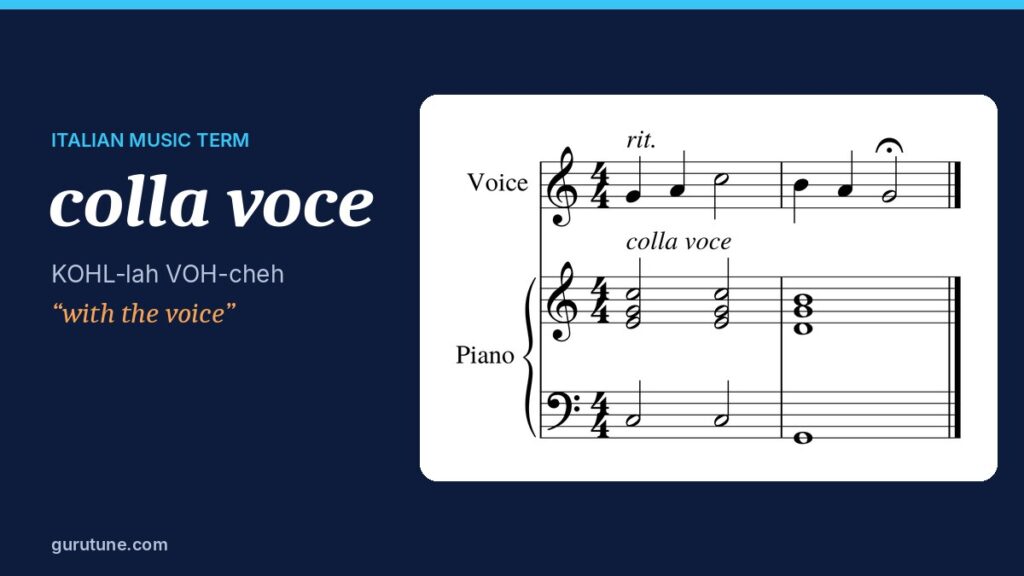
Colla voce is Italian for “with the voice”. When the words appear in the accompaniment of a song or an aria, the pianist or the orchestra stops leading the tempo. From that point the singer decides when each note arrives, and everyone else follows.
How to pronounce colla voce
Say it as KOHL-lah VOH-cheh. The double L in colla is held a little, as Italians do with doubled consonants, and the C in voce sounds like the CH in “cheese”.
Where you will find it
The marking is printed in the accompanying part, never in the vocal line itself. A singer does not need permission to sing freely. The instruction is there for the people who must stay with the singer.
You will meet it most often at these points in vocal music:
- Before a high note that the singer may want to hold longer than written
- At the end of a phrase where the melody slows down
- Over a fermata, the pause sign that lets a note last as long as the performer wishes
- In passages that sound like speech, where the words dictate the rhythm
- Before a short cadenza, a free and decorative solo moment
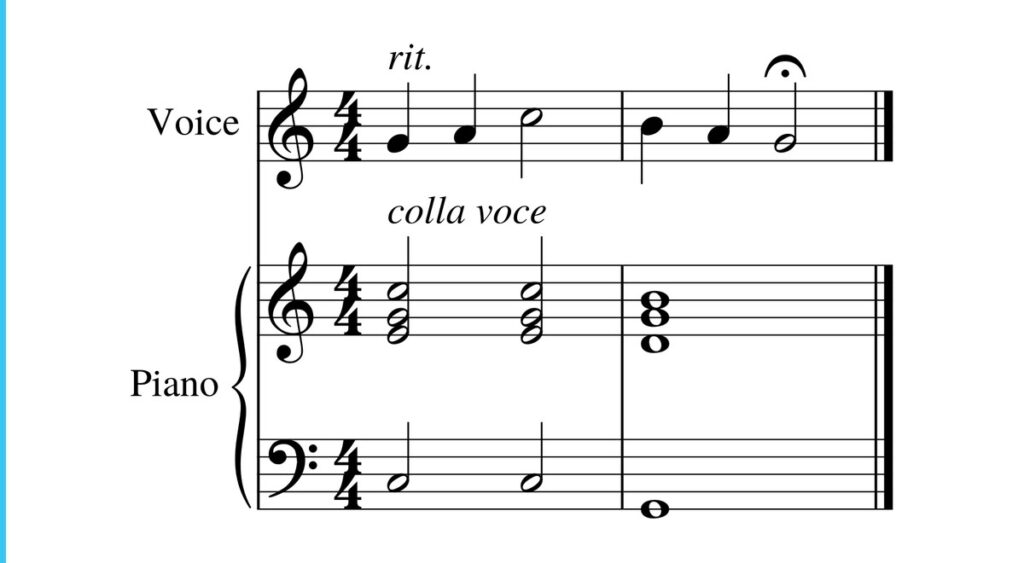
What the accompanist actually does
Following a singer sounds simple, yet it is one of the hardest skills in ensemble playing. The pianist cannot wait to hear a note before playing the chord underneath, because the sound would arrive late. Good accompanists solve this by watching more than listening.
Breathing is the strongest clue. A singer always inhales before a new phrase, and that breath shows when the next note will start. Experienced pianists breathe together with the singer, so both begin at the same moment.
Consonants give a second clue. In a word like “love”, the L comes before the vowel. Professionals place their chord on the vowel, because the vowel is where the note really sounds.
On held notes the accompanist simply waits. Nothing moves until the voice moves. When the singer releases the note or starts the next syllable, the accompaniment continues.
When does colla voce stop
The freedom lasts until the composer cancels it. Usually that happens with the words a tempo, meaning “back to the original speed”. From there the music returns to a steady pulse, and the accompanist leads again.
If no a tempo is written, musicians decide together where strict time resumes. Rehearsal is the place to agree on this, not the concert.
Colla voce, col canto and colla parte
Col canto means “with the song”. It asks for exactly the same thing as colla voce, and composers use the two expressions interchangeably.
Colla parte means “with the part”. It is the wider version of the same idea: follow whichever solo line is leading, whether a voice, a violin or a flute. Colla parte also has a second meaning, which we explain in our separate article about that term.
Tips for singers
The marking gives you freedom, but it also gives you responsibility. Your accompanist can only follow what is clear.
- Show your breath before every phrase, so it can be seen
- Keep your tempo changes logical, slowing down and speeding up smoothly
- Decide in rehearsal how long you will hold the important notes
- Look at the pianist at the end of long pauses
A simple practice exercise
Pianists can train this skill without a singer. Play a recording of a slow aria and accompany it with simple chords. Try to place each chord at exactly the moment the voice changes note. Repeat with a different singer, and notice how differently each one shapes the same melody.
Free printable card
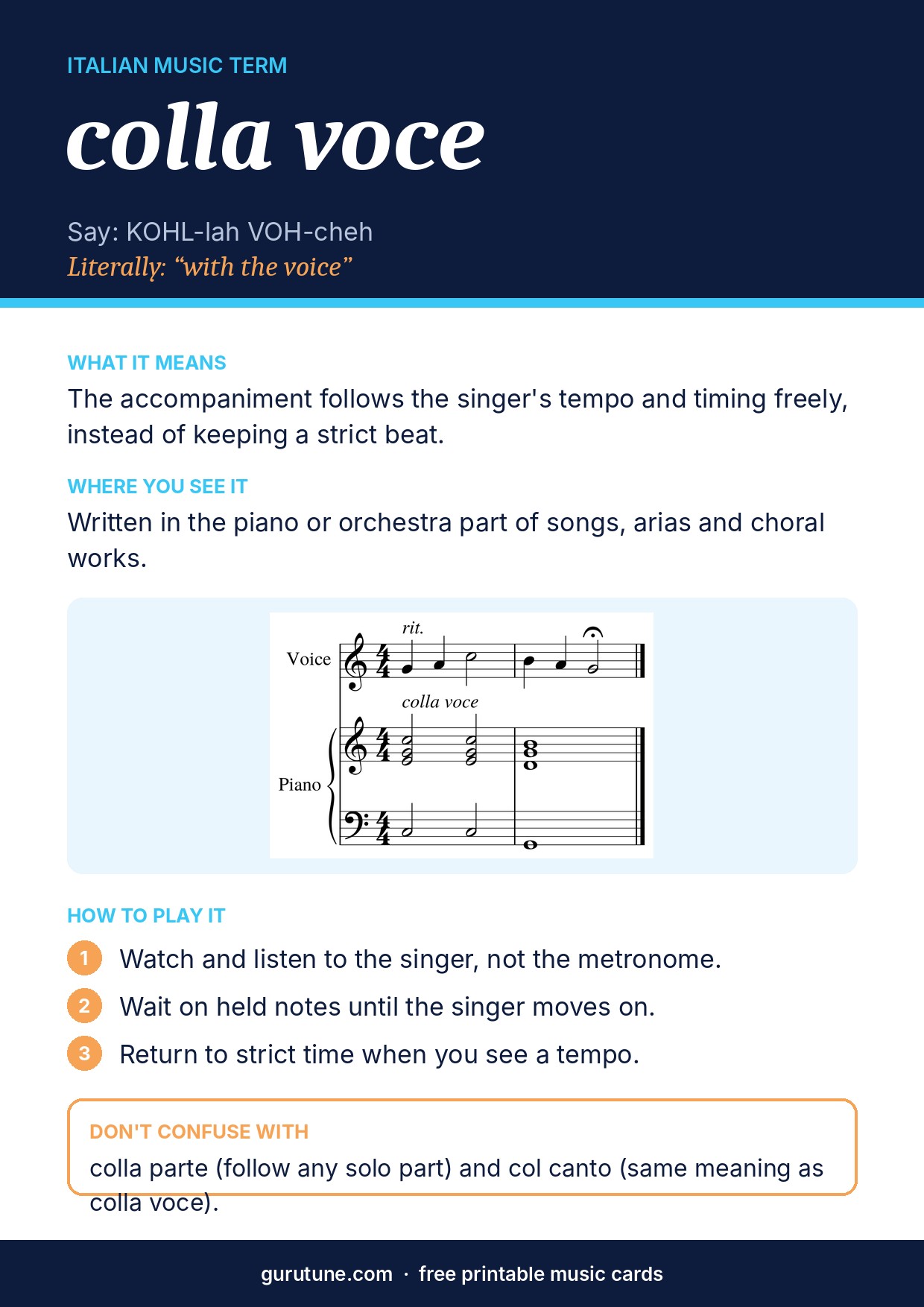
Print this card on A4 and keep it in your music folder or on the stand. Click the image to open it in full size.
For the short definition, see colla voce in our music dictionary.
Frequently asked questions
What does colla voce mean in music?
Colla voce is Italian for “with the voice”. It tells the accompanist to follow the singer’s tempo and timing freely, instead of keeping a strict beat.
Where is colla voce written in a score?
It is written in the accompaniment, such as the piano or orchestra part. The vocal line itself does not carry the marking.
How do you pronounce colla voce?
It is pronounced KOHL-lah VOH-cheh, with the C in voce sounding like CH in “cheese”.
What is the difference between colla voce and col canto?
There is no practical difference. Col canto means “with the song”, and both expressions ask the accompanist to follow the singer.
What is the difference between colla voce and colla parte?
Colla voce refers to a singer. Colla parte means following whichever part is leading, which could also be an instrument.
How long does colla voce last?
It lasts until the composer writes a tempo, which brings back the original steady speed.