
The bass clef is the symbol that tells a musician to read the staff in the low range. If you play cello, bassoon, trombone, tuba or bass guitar, or the left hand on piano, this is the clef you will meet every day. This guide shows how it works, how to name every note quickly and how to avoid the classic beginner errors.
What is the bass clef
Written music sits on a staff of five horizontal lines. On its own, a staff says nothing about pitch. A clef at the beginning fixes one note, and every other note is counted from that point.
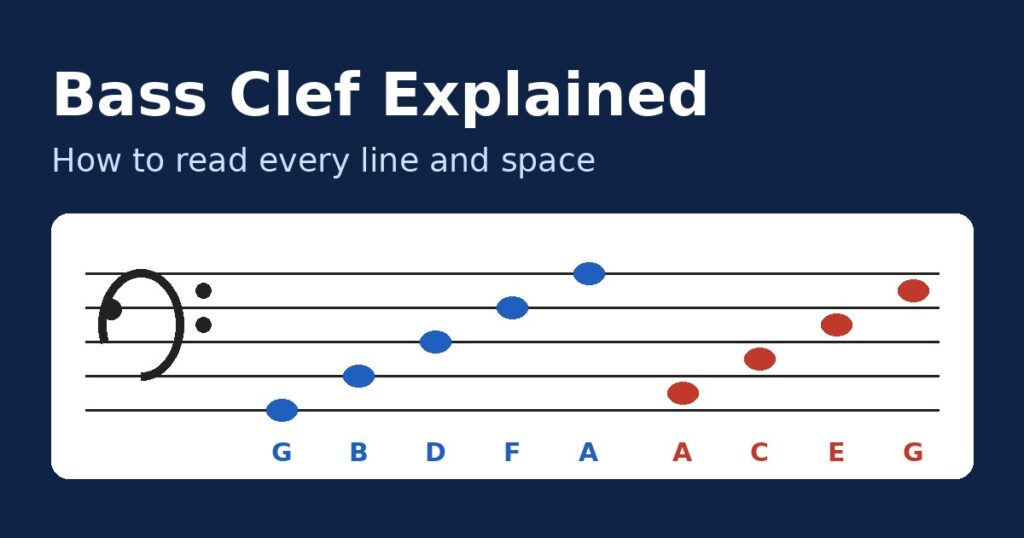
The bass clef fixes F below middle C on the fourth line from the bottom. Its curl starts on that line, and the two dots sit just above and below it. That is why musicians also call it the F clef. Historically, the symbol grew out of a handwritten letter F used by medieval scribes. 𝄢 GBDFA ACEG Blue: notes on the lines. Red: notes in the spaces.
How to read the lines
From the bottom up, the five lines are G, B, D, F and A. Most teachers use the sentence “Good Boys Do Fine Always” to remember them. Say it out loud a few times while pointing at each line, and the order sticks surprisingly fast.
How to read the spaces
The four spaces between the lines are A, C, E and G, again counted upwards. The usual memory aid is “All Cows Eat Grass”. Notice that the spaces start on A, one step above the bottom line G.
Ledger lines and middle C
Some notes fall above or below the staff. They are written on short extra lines called ledger lines. Middle C, the note in the centre of a piano keyboard, sits on one ledger line just above the bass staff. The same pitch appears one ledger line below the treble staff, which is how the two clefs connect.
Going down, the first ledger line under the staff is E, with F in the space between it and the bottom line. Low instruments such as tuba and double bass use these notes constantly.
Landmark notes: a faster way to read
Instead of counting from the bottom line every time, learn a few fixed landmarks and read from the nearest one. Good anchors are:
- Low G on the bottom line
- F on the fourth line, marked by the dots
- Middle C on the first ledger line above
Any note is then at most two or three steps away from a landmark. Experienced readers work this way, and it is much quicker than reciting the whole memory sentence.
Instruments that use the bass clef
Every instrument or voice with a deep range relies on this symbol. Typical examples are cello, double bass, bassoon, contrabassoon, trombone, bass trombone, euphonium, tuba, timpani, bass guitar and the male bass voice.
Piano music combines two clefs. The right hand reads the treble staff on top, while the left hand reads the bass staff underneath. Together they form the grand staff, joined by a brace on the left.
Double bass and bass guitar are a special case. Their parts are written one octave higher than they sound. This keeps the notes inside the staff instead of hanging far below on many ledger lines.
Bass clef compared with treble clef
The treble clef, or G clef, covers the higher register used by flute, violin, trumpet and the right hand on piano. The same position on the staff carries a different name in each clef. In bass, every line and space is two letter names higher than in treble: the bottom line is G rather than E, and the top line is A rather than F.
A handy trick for readers who already know treble: find the treble name, then move two letters up the alphabet. E becomes G, F becomes A, and so on.
Other clefs you will meet
The bass clef is not alone. Viola players read the alto clef, where middle C sits on the middle line. Cellists, bassoonists and trombonists switch to the tenor clef for high passages. Drummers use the percussion clef, which shows instruments rather than pitches.
Common beginner mistakes
Reading with treble habits. Every note comes out wrong by two letter names. The fix is to practise bass reading as its own skill, not as a translation.
Forgetting the F line. When a clef change appears in the middle of a piece, players lose their bearings. Look for the two dots and restart from F.
Ignoring rhythm. Naming the pitch is only half the job. Each note also has a length, such as a quarter note, and the bar follows the time signature at the start.
How to practise reading bass clef
Ten minutes a day beats an hour once a week. Name notes from flashcards, then from simple melodies, and finally from real pieces in your own instrument’s range. Saying the letters aloud while you play links the symbol, the name and the sound.
Once note names feel automatic, move on to patterns. Practising scales in the bass register trains your eye to see steps and skips. Later, the circle of fifths helps you understand key signatures. Both skills feed directly into analysing music on paper.
Frequently asked questions
Why is it called the F clef
The two dots surround the fourth line, and that line is F. The symbol itself developed from an old handwritten F.
What is the lowest note on the bass staff
Without ledger lines, the lowest is G on the bottom line. Lower notes need extra short lines underneath.
Where is middle C in the bass clef
Middle C sits on one ledger line directly above the staff.
Is bass clef harder than treble clef
No. It only feels harder because most people learn treble first. With daily practice both become equally easy.
Does bass guitar use bass clef
Yes. Bass guitar music is written in bass clef, one octave above the sounding pitch. Ordinary guitar uses treble clef.
Can a piece change clef midway
Yes. Cello, bassoon and trombone parts often move to tenor clef for high passages, then return when the line drops again.
How long does it take to learn bass clef
Most beginners can name every note on the staff after one or two weeks of short daily practice. Reading at playing speed takes a few months.
Which hand reads bass clef on piano
The left hand, in most piano music. Composers sometimes switch it to treble clef when the part climbs high.