
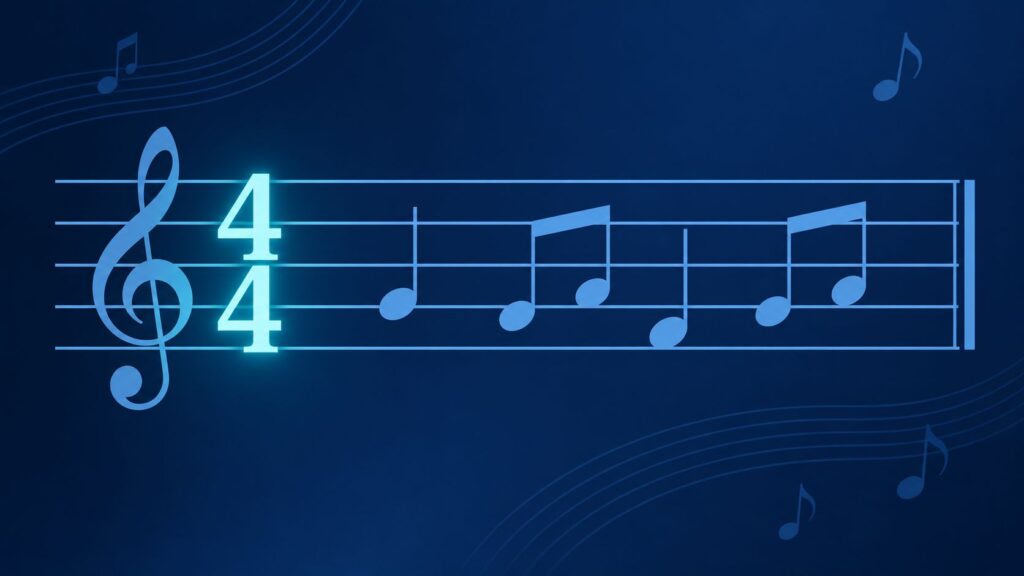
A time signature is the pair of numbers written at the beginning of a piece of music, right after the clef and key signature. It tells you two things: how many of a given note value fit into each measure, and what that note value is. Once you can read a time signature, you can tell at a glance whether a piece will feel steady and marching, gently swaying, or deliberately off-balance.
How to Read a Time Signature
A time signature looks like a fraction, but it isn’t one. The two numbers are read independently.
The top number tells you how many of the indicated note-value units are contained in a measure.
The bottom number indicates the note value used as the basic notational unit: a 4 means quarter notes, an 8 means eighth notes, and a 2 means half notes. In simple meters, this note value usually is the beat itself. In compound meters such as 6/8, the main beat is normally a dotted quarter note, made up of three of the eighth notes the bottom number refers to.
So a time signature of 3/4 means three quarter-note beats per measure. A time signature of 6/8 has two main beats per measure, each a dotted quarter note built from three eighth notes. The numbers describe structure, not tempo. A piece in 3/4 can be played fast or slow.
Simple Time Signatures
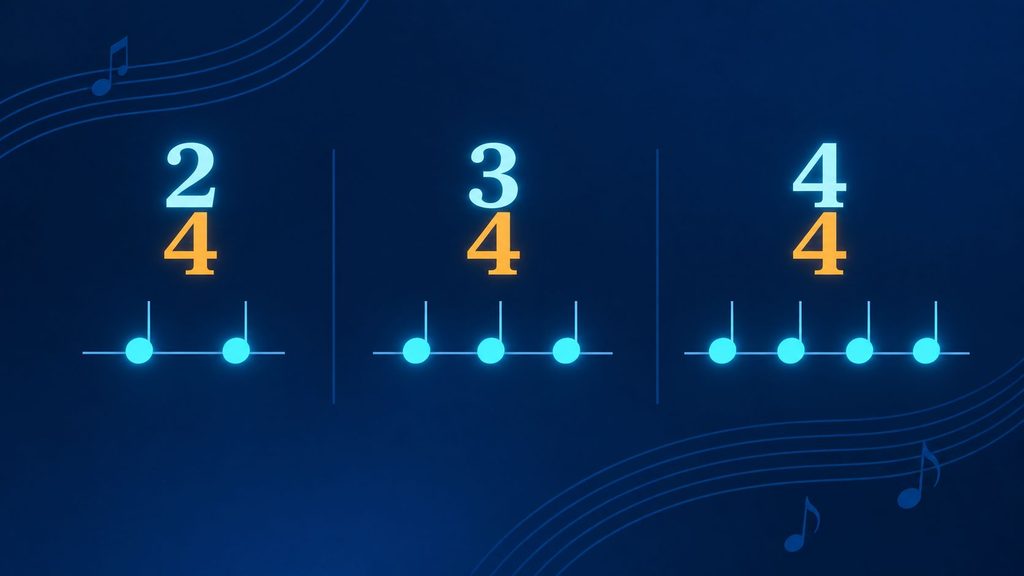
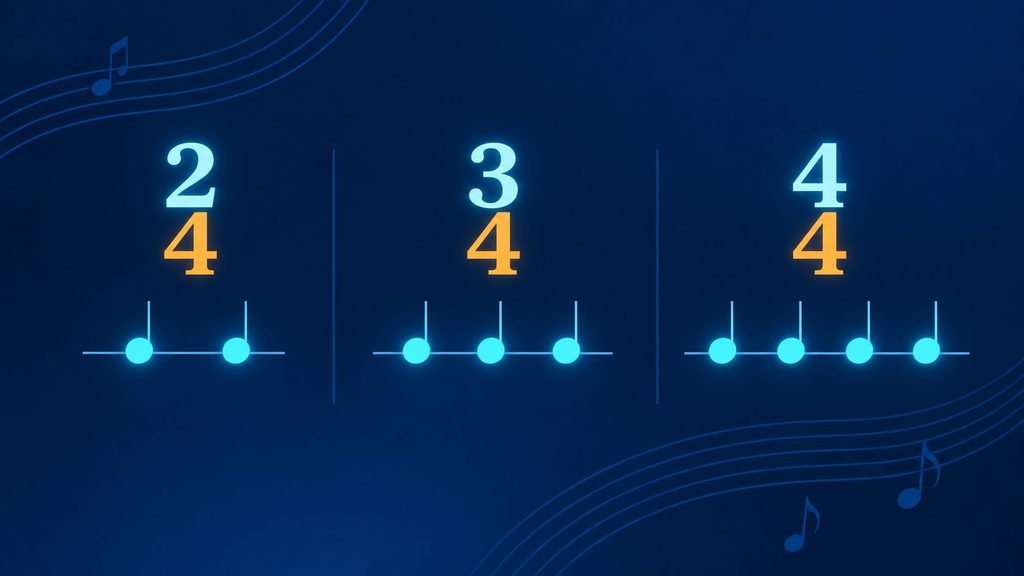
In a simple time signature, each beat divides naturally into two equal parts. The most common simple time signatures are:
4/4 (common time): Four quarter-note beats per measure. It is by far the most widely used time signature in Western music and is especially common in pop, rock, and classical music. It’s so common that it’s sometimes marked with a large C instead of the numbers.
3/4: Three quarter-note beats per measure. This is the time signature of the waltz, giving music a gentle “ONE-two-three” lilt.
2/4: Two quarter-note beats per measure. Common in marches and polkas, where a strong, steady “ONE-two” drive is needed.
2/2 (cut time): Two half-note beats per measure, felt in a broad two rather than four, common in fast marches and some classical pieces.
Compound Time Signatures
In a compound time signature, the main beat divides naturally into three equal parts instead of two. The bottom number of a compound time signature refers to those smaller subdivisions, not the main beat itself. In 6/8, for example, the main beat is a dotted quarter note made up of three eighth notes, giving two main beats per measure, not six.
6/8: Two main beats per measure, each a dotted quarter note built from three eighth notes. Common in ballads, some rock songs, and Irish jigs.
9/8: Three main beats per measure, each a dotted quarter note built from three eighth notes. Used for a fuller, more sweeping compound feel.
12/8: Four main beats per measure, each a dotted quarter note built from three eighth notes. Common in blues and doo-wop, where it often produces a strong triplet or shuffle feel, though that quality comes from how the music is played, not automatically from the time signature alone.
Simple vs. Compound: What’s the Actual Difference?
The confusion between these two usually comes down to one question: does each beat split into two, or into three? If you tap your foot to a song and each tap naturally wants to divide into “1-and” (two parts), you’re in simple time. If each tap wants to divide into “1-and-a” (three parts), you’re in compound time. A 3/4 waltz and a 6/8 ballad can sound deceptively similar at first listen, since both group notes in threes, but 3/4 has three separate beats per measure, while 6/8 has only two main beats, each made of three eighth notes.
Odd and Irregular Time Signatures
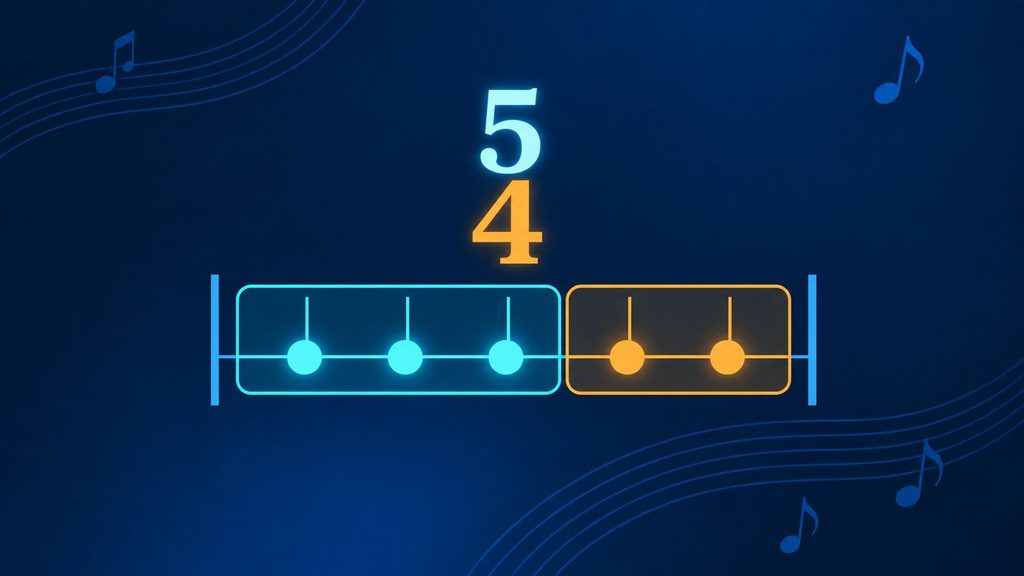
Not every piece of music fits into a tidy pattern of twos and threes. Odd or asymmetric meters are commonly organized into groups of two and three, creating an uneven or irregular grouping of beats or subdivisions.
5/4: Often felt as a 3+2 or 2+3 grouping. Dave Brubeck’s “Take Five” is the most famous example, and it remains one of the clearest ways to hear how a 5/4 groove locks in once you feel the internal grouping.
7/8: Usually felt as 2+2+3 or a similar combination. Common in Balkan folk music and used deliberately by prog rock bands to create a sense of forward tension.
7/4: A seven-beat meter using quarter notes as the basic beat unit. Used memorably in Pink Floyd’s “Money,” where the main sections are in 7/4, while the guitar solo moves into 4/4.
Bands like Tool, Dream Theater, King Crimson, and Meshuggah have built entire careers around shifting and combining odd time signatures, sometimes changing meter multiple times within a single song. For a listener, the effect is a piece of music that never quite lets you settle into a predictable pulse, which is exactly the point.
Why Time Signatures Matter
A time signature isn’t just bookkeeping for musicians reading a score. It shapes how a piece of music actually feels to a listener, whether it marches, sways, shuffles, or deliberately stumbles. Changing a melody from 4/4 to 3/4 without altering a single note can turn it from a march into a waltz. Understanding time signatures is one of the fastest ways to understand why two pieces of music with similar melodies can feel completely different.
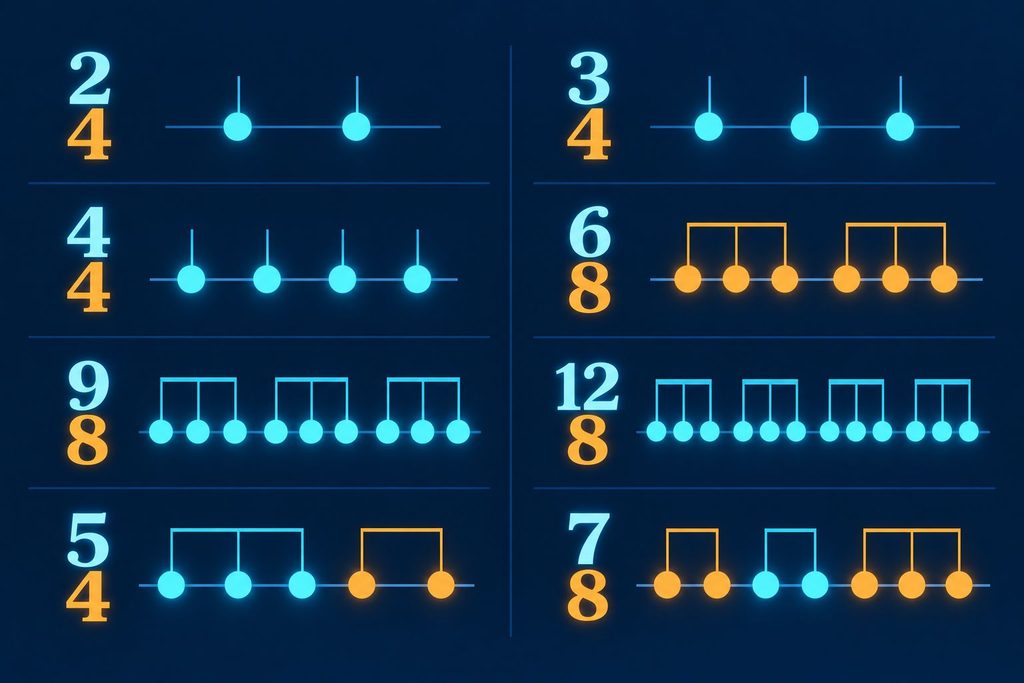
Quick Reference: Common Time Signatures
- 2/4 – March, polka. Two quarter-note beats per measure.
- 3/4 – Waltz. Three quarter-note beats per measure.
- 4/4 – Pop, rock, most Western music. Four quarter-note beats per measure.
- 2/2 – Fast marches, cut time. Two half-note beats per measure.
- 6/8 – Ballads, jigs. Two main beats, each a dotted quarter note built from three eighth notes.
- 9/8 – Compound triple feel. Three main beats, each a dotted quarter note built from three eighth notes.
- 12/8 – Blues, shuffle feel. Four main beats, each a dotted quarter note built from three eighth notes.
- 5/4 – Grouped as 3+2 or 2+3. Example: “Take Five.”
- 7/8 – Grouped as 2+2+3 or similar. Common in Balkan and prog rock music.
- 7/4 – Seven-beat meter using quarter notes. Example: “Money” by Pink Floyd.
Once you can hear the difference between a beat splitting into two and a beat splitting into three, reading any time signature on the page becomes a matter of confirming what your ear already knows.